What Durham CT Homeowners Get From an American Standard Tune-Up
AC maintenance Durham CT is not a checkbox. It is a disciplined tune-up that catches wear, restores capacity, and helps a system run through July and August without drama. In Durham, Middletown, Middlefield, Killingworth, Haddam, and Madison, most breakdowns tie back to small parts that gave warning signs long before they failed. A proper American Standard tune-up reads those signs and fixes what matters while the house is still cool.
This article explains what a thorough American Standard tune-up includes for homes along Route 17, Route 79, and Route 68, how it differs on R-410A versus newer R-454B equipment, what it costs in 2026 in Middlesex County, and why timing matters in a climate that spends more time at part-load than at peak. It focuses on AC maintenance Durham CT for residential homes and small commercial properties that cannot afford to lose cooling in a heat wave.
Why a Durham-focused tune-up matters
Central Connecticut sits in climate zone 5A. Summer design temperature runs about 86 to 88 degrees. Real life is a string of warm, humid days with a few spikes into the 90s. Systems run long, steady cycles. They do not like clogged filters, matted coils, or weak capacitors. Condensate pans work hard in high humidity near the Coginchaug River and along the Connecticut River. A Durham tune-up addresses those exact loads, in the housing stock that defines the 06422 and 06457 zip codes, from 1950s ranches to newer colonials near the Higganum Road corridor and Lake Beseck.
On older retrofits in ranch and split-level homes, ductwork was added later. Return grilles run small. Static pressure runs high. A good technician knows to measure external static pressure, check blower tap settings, and adjust for the right airflow. That preserves capacity and helps the American Standard evaporator coil avoid freezing on humid evenings. On newer variable-speed systems, the focus shifts to ECM blower calibration, proper thermostat staging, and clean coils to protect SEER2 efficiency.
What an American Standard tune-up includes in practice
Every brand benefits from careful service, but American Standard systems reward measurement-driven work. The components are robust, and they respond when a technician takes time to verify charge and electrical health. The result is reliable run time and even temperatures upstairs during a string of 90-degree days along Route 9 or I-91 commutes.
Here is what a proper AC maintenance Durham CT visit delivers on a central air or heat pump system, with plain-English translation in parentheses:
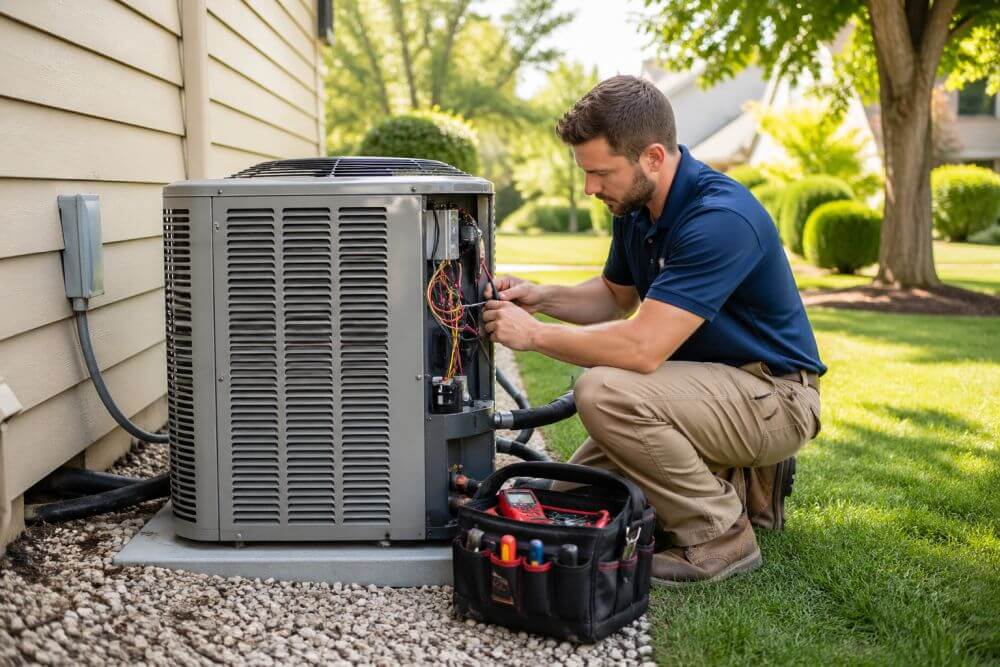
- Capacitor microfarad test and replacement if out of spec (the small part that gives the compressor and condenser fan motor the push to start) Contactor inspection for pitting and coil resistance (the high-voltage switch that turns the condenser on and off) Condenser coil cleaning with proper chemistry and low-pressure rinse (dirt here cuts heat rejection, which lowers capacity and raises energy use) Evaporator coil inspection and surface cleaning access if fouled (a dirty indoor coil chokes airflow and ices up on humid days) Refrigerant charge check by subcooling and superheat with ambient correction (not just a “sight glass” glance; this verifies the actual refrigerant level) TXV function check when applicable (the valve that meters refrigerant into the coil) Blower motor amp draw and ECM calibration or PSC capacitor match (airflow is the backbone of comfort and capacity) External static pressure and return duct inspection (undersized returns are common in 1950s to 1980s homes across Durham and Middletown) Condensate drain clearing and pan treatment (prevents clogs and water damage during July humidity spikes) Thermostat calibration and staging check on AccuLink, Nest, Ecobee, or Honeywell (accurate setpoint and proper cycling) Electrical connection torque check and wire condition (loose connections cause intermittent shutoffs and board damage) Safety review for A2L-ready systems where applicable, including leak detector and ventilation checks on newer R-454B equipment (newer refrigerants require added diligence)
Technicians also verify temperature split across the indoor coil, confirm supply and return temperatures, and assess airflow at key registers upstairs where heat tends to collect. On American Standard air handlers and furnaces with variable-speed blowers, they log blower CFM targets and confirm that filter resistance and duct sizing allow the fan table to hit those targets. On older constant-torque or PSC motors, they confirm correct tap settings and matching run capacitors. This is where many systems quietly give back a half-ton of effective capacity without a homeowner realizing why the second floor in Madison will not drop below 77 on the hottest days.
Local homes need different checkpoints by era and layout
Housing stock across Durham, Middlefield, and Higganum is not uniform. The most productive tune-ups match checkpoints to typical constraints by era:
Pre-1850 colonial and saltbox homes around Durham Center and Haddam Center often have retrofitted ductwork tucked into tight chases. Returns are limited. A tune-up must measure static pressure and look for bottlenecks at the return plenum and return grilles. Upgrading to a deeper media filter cabinet reduces restriction and protects the evaporator coil. Whole-home dehumidification pairs well with these tighter, smaller ducts that struggle to move high CFM on muggy days.
1950s through 1980s ranch and split-level homes in Durham North, Wallingford, and Meriden often inherited oil-to-gas conversions and retrofit central AC in the 1990s or 2000s. Evaporator coils here often show nicotine staining, attic dust, or construction debris from past renovations. A tune-up brings coil surfaces back to spec and checks blower wheel cleanliness. Many use single-stage American Standard Silver or Gold series condensers matched to standard furnaces. They respond well when the charge is dialed by subcooling and superheat, and when the outdoor condenser coil is fully rinsed to daylight.
1990s through 2010s colonials across the Higganum Road corridor, Lake Beseck, and North Madison usually shipped with high-efficiency furnaces and air conditioning from day one. These systems often include ECM variable-speed blowers and, in some American Standard Gold and Platinum builds, communicating AccuLink controls. A tune-up confirms blower calibration, verifies thermostat staging logic, checks that zone control panels are sequencing dampers correctly, and ensures that MERV 13 to 16 media filters are not overloading the fan at high speed. A quick static measurement and fan table check can bring comfort back to rooms over garages on Route 147 where temperature drifts appear each August.
Refrigerant reality in 2026: R-410A service and R-454B awareness
Many Durham systems still run on R-410A. Some of the newest American Standard units introduced after 2025 ship with R-454B, an A2L mildly flammable refrigerant. AC maintenance Durham CT needs to reflect both. On R-410A equipment, a tune-up confirms charge targets with subcooling and superheat, looks for oil staining at flare joints and service valves, and inspects the TXV bulb mount. On R-454B systems, technicians follow A2L-safe handling procedures, verify leak detector operation where installed by manufacturer design, and keep airflow and coil cleanliness high to protect efficiency under SEER2 test conditions.
Either way, guesswork is gone. Outdoor ambient, indoor wet-bulb, line temperature, subcooling, and superheat define the charge decision. Adding refrigerant without numbers is not acceptable. Certified technicians with EPA 608 credentials handle both refrigerants correctly, and they document readings for future reference. That record matters when systems age into their second decade on homes along Main Street or near the Durham Fair Grounds, where a slow leak might take a full season to show up as a two- or three-degree comfort slide.
The surprising local failure pattern no one expects
Years of AC maintenance Durham CT data show a repeatable pattern. Roughly 70 percent of capacitor-related failures in Durham and Middletown cluster in two windows. The first two weeks of June see a spike when outdoor temperatures jump and systems cycle hard after mild spring use. The last week of August adds a second spike as evening temps drop and daytime highs remain high, which stresses aging capacitors through wide daily swings. This thermal cycling in older American Standard, Trane, Carrier, and Lennox condensers produces the familiar call: condenser hums, fan does not spin, or the breaker trips.
A $150 to $200 spring tune-up catches weak capacitors by testing actual microfarads against rating, replaces them on schedule, and prevents a $400 emergency repair with an after-hours fee when the first heat wave lands. That is the practical math homeowners remember after a summer stuck at 78 upstairs during a birthday party in Guilford or Cromwell.
What AC maintenance costs in Middlesex County in 2026
Service costs vary by system complexity and access. The 2026 ranges below match what homeowners from 06422 to 06457 typically see:
- Single-system AC tune-up: $120 to $250, includes multi-point inspection and cleaning Premium tune-up with deep coil service and static pressure testing: $200 to $400 Annual maintenance plan covering heating and cooling: $300 to $600 per year
Commercial rooftop units in Middletown’s South Farms or along Route 9 often run higher due to roof access and larger tonnage. Those quotes include coil cleaning, belt checks, blower bearing checks, and filter schedules suited to business hours and occupancy loads. The plan that fits a Lake Beseck ranch is not the plan for a Westfield retail space.
American Standard specifics: Platinum, Gold, and Silver tune-up nuances
American Standard Platinum variable-speed systems with communicating AccuLink controls need thermostat and board verifications along with standard mechanical checks. A tune-up confirms firmware versions when applicable, verifies outdoor unit compressor modulation behavior, and confirms that indoor blower CFM aligns with equipment tables. The variable-speed compressor’s efficiency depends on clean outdoor coils and accurate charge. Communicating controls make staging smooth, but only when sensors are clean and low-voltage connections are tight.
American Standard Gold two-stage systems trade on comfort balance. A tune-up focuses on correct low- and high-stage performance, contactor health, and clean condenser and evaporator coils that let the system stay in low stage longer. That means quieter runs and steadier humidity control for homes near the Coginchaug River corridor.
American Standard Silver single-stage systems need solid fundamentals. Correct charge by subcooling and superheat, clean coils, a healthy capacitor, and a true temperature split give back most of the performance homeowners expect. Many Silver systems in Durham and Middlefield are paired with non-communicating thermostats like Honeywell or Sensi. A tune-up calibrates those controls and verifies cycle length that avoids short cycling on mild days.
Airflow and duct discipline grounded in Connecticut homes
Airflow problems steal comfort from second floors across Durham, Wallingford, Cheshire, and Meriden. A tune-up that never measures static pressure leaves performance on the table. The test is quick. A manometer reads pressure before and after the indoor coil. Numbers above manufacturer limits point to tight filters, dirty coils, small return ducts, or closed dampers. Correcting those issues often brings room temperatures into line without touching the outdoor unit.
In homes along Cherry Hill Road, Maiden Lane, and Pickett Lane, technicians often find return restrictions at the furnace base or reduced filter area from an undersized cabinet. Moving to a media filter cabinet with a larger face area drops pressure and raises airflow. On zone systems with a zone control panel, the tune-up checks damper travel and bypass damper settings to prevent coil freeze-ups when only a small zone calls for cooling.
Coil cleaning that preserves SEER2 performance
Most modern American Standard systems rate between 14 and 22 SEER2 depending on tier and match. Dirt drags those numbers down. An outdoor condenser coil that cannot see daylight through its fins runs hot, forces higher head pressure, and burns power. A tune-up uses coil-safe cleaner and a controlled rinse. No high-pressure blast that bends fins. Indoors, technicians access the evaporator coil, assess fouling, and clean as needed. That protects the thermostatic expansion valve’s metering behavior and reduces icing on humid evenings in Madison and Guilford.
Homeowners often ask why their energy bill rose even though the house still feels cool. The answer is usually found in coil condition and charge accuracy. A technician who takes time to log subcooling and superheat on a midsummer day on Route 79 can show exactly where the energy was going and bring it back into line.
Condensate and humidity control in the Lower Connecticut River Valley
Humidity drives comfort in Middlesex County. A clean condensate drain keeps water moving from the pan to the pump or floor drain. Algae blooms in affordable AC maintenance CT July can block a trap. The result is an overflow and water damage around finished basements in Rockfall or powder rooms near the air handler. A tune-up clears the line and adds a pan treatment. On systems with overflow switches, technicians test cutout operation and confirm wiring to the air handler or furnace. In some older homes, adding a float switch is simple insurance against a wet ceiling in South Farms.
For homes that still run humid, especially near forested lots in Killingworth and Higganum, a whole-home dehumidifier makes sense. It works with central air and draws moisture even on shoulder days when the AC does not run long enough. That add-on sits outside the tune-up, but a maintenance visit is the right time to discuss sizing and return-duct connections if needed.
The thermostat and controls check that protects comfort upstairs
Controls do more than set temperature. On American Standard AccuLink systems, the thermostat communicates with the outdoor unit and indoor blower to manage stages and airflow. A tune-up verifies correct sensor calibration, staging thresholds, and fan profiles. On Nest, Ecobee, Honeywell, or Sensi, the check confirms anticipator and differential settings, verifies C-wire health, and rules out common smart thermostat wiring issues that cause intermittent condensate pump trips or short cycling.
In multi-zone homes in North Madison or Cromwell, the tune-up also checks the zone control panel. Loose low-voltage connections or a sticky damper creates hot or cold spots and can push the evaporator into freeze risk. Simple damper adjustments can fix rooms over garages that always lag.
Numbers that matter on the service ticket
AC maintenance Durham CT should end with data. Homeowners and property managers should expect a written record with:
Supply and return temperatures with calculated temperature split under load, outdoor ambient, indoor relative humidity, static pressure readings with manufacturer target, blower amp draw against nameplate, capacitor microfarads versus rating, contactor condition, and subcooling and superheat values. Those readings let a technician see trends during the next visit. They also support warranty claims with American Standard and other brands if a part fails early within a 10-year limited parts warranty window.
What maintenance reveals and how decisions get made
Sometimes a tune-up finds bigger issues. A pitted contactor with visible arcing is straightforward. A compressor with high start amps and rising thermal trips is not. A Durham homeowner needs straight talk about repair versus replacement, realistic 2026 parts and labor costs, and how much life the system likely has left. Typical repair ranges in Connecticut this year include $150 to $400 for a capacitor, $200 to $500 for a contactor, $300 to $800 for a refrigerant recharge with a basic leak search, $400 to $1,200 for a blower motor, and $1,500 to $3,500 for a compressor on older units. Those numbers guide decisions when a 16-year-old system in 06422 faces multiple component failures.
If replacement is on the table, a licensed contractor will run a Manual J load calculation, confirm duct capacity under Manual D, and select equipment under Manual S. That prevents oversizing that causes short cycles and humidity complaints. For homeowners exploring cold-climate heat pumps, Energize CT and Eversource incentives can be significant, often between $1,500 and $7,500 for qualifying installations. That discussion belongs after the tune-up clarifies the system’s condition, not before.
Commercial and multifamily considerations along Route 17 and Route 9
Small offices, storefronts, and multifamily buildings from Middletown’s Westfield to Portland and East Hampton rely on steady cooling during business hours. AC maintenance here adds belt checks, blower bearing lubrication where applicable, filter size reviews for extended run time, and rooftop safety. Many sites run American Standard, Trane, and Carrier light commercial units between 3 and 10 tons. Scheduled coil cleaning and documented pressure readings keep energy use predictable and prevent surprise failures on delivery days in Maromas or Tylerville.
Scheduling that fits the Connecticut cooling season
Book AC maintenance Durham CT before the first 90-degree week forecast. In practical terms, that means April through May for most of Middlesex County. Systems that get tuned before school lets out in June avoid the capacitor failure spike mentioned earlier. For homeowners who miss spring, early August is the second window before the late-August thermal cycling wave. Properties near the Durham Fair Grounds also benefit from a quick pre-event check, since guests and family traffic push equipment harder for a few days.
For homes with hydronic or forced-air heating, an annual maintenance plan that pairs spring cooling service with fall heating service saves trips and catches combustion and blower issues before the first cold snap. Many families in Rockfall and Higganum choose that plan because winter failures in our heating-dominated climate can put pipes at risk when temperatures drop toward 0 degrees.
Brands seen daily across central Connecticut
American Standard is common across Durham, but technicians service Trane, Carrier, Lennox, Bryant, Bosch, Rheem, and Goodman every week. Ductless systems from Mitsubishi Electric and Daikin show up in sunrooms, finished basements, and additions that sit beyond the main duct system. Maintenance on those units targets clean filters, spotless indoor and outdoor coils, correct drain routing, and controls checks that keep H2i or inverter-driven compressors performing in humid conditions.
This broad manufacturer experience matters when a mixed-brand property needs service. A home might have an American Standard furnace with a Lennox coil and a Goodman condenser from a past replacement. The tune-up still uses subcooling and superheat, airflow verification, and electrical tests to pull the system back into balance.
AC maintenance Durham CT and the road map to the job
Dispatch from 57 Ozick Dr Suite i in 06422 puts technicians within minutes of most calls across the Route 17 corridor. Travel to Middletown 06457 runs about eight miles, Middlefield 06455 about six, Killingworth 06419 about ten, and Madison 06443 about twelve along Route 79. Wallingford 06492 and Meriden 06450 sit to the west along Route 68 and Route 147. Cromwell 06416, Portland 06480, and East Hampton 06424 sit downstream along the Connecticut River. The route matters when the forecast jumps twenty degrees and dozens of homes need the same quick fix. A tune-up that reduces those urgent calls helps everyone.
What homeowners actually feel after a proper tune-up
Several outcomes show up the same day. First, the upstairs cools more evenly during the afternoon. Second, the condenser outside sounds smoother and cycles less often. Third, the thermostat holds setpoint without the two-degree drift that used to show up after dinner. Over the month, the energy bill often drops back to last year’s level, or lower, if coils were dirty and charge was off. On communicating American Standard systems, fans run smarter and quieter when staged and calibrated correctly.
These are not abstract results. They are what happens when subcooling is correct, superheat is in range, coils are truly clean, and the blower moves the cubic feet per minute it was designed to move. The system does its job without calling attention to itself while the family gets ready for a weekend at Hammonasset Beach State Park or a night at Wesleyan University in Middletown.
Answers to two common Durham questions
How long does a solid tune-up take? For a typical single-system American Standard central AC with good access, about 60 to 90 minutes. If the evaporator needs deeper cleaning or the condensate line is blocked, expect 30 to 45 minutes more. Most visits across Durham Center, Madison Center, and South Farms fit within a morning or afternoon window.
Will a tune-up void my manufacturer warranty? No. Routine maintenance is recommended by manufacturers including American Standard. In fact, documented maintenance helps with warranty decisions if a control board or compressor fails under a 10-year limited parts warranty. A Connecticut-licensed contractor with S-1 unlimited heating and cooling credentials and EPA 608 certification protects that record.
What gets shared with the homeowner or manager after service
The best evidence is a written or digital report that includes readings, photos of cleaned coils, before-and-after microfarad measurements, and notes on any parts replaced such as capacitors or contactors. For systems with communicating thermostats, technicians add event logs that show normal operation after adjustments. For duct systems with chronic room issues, a static pressure reading and a recommendation for return upgrades or duct sealing give a clear action path.
AC maintenance Durham CT: when a tune-up becomes an upgrade conversation
If a 20-year-old system in Middlefield 06455 shows a leaking evaporator coil or a compressor with high start amps and low performance, the conversation may shift. Replacement estimates for 2026 range roughly from $5,500 to $9,000 for a standard 2 to 3 ton single-stage central AC installed, $7,500 to $13,000 for two-stage premium tiers, and $10,000 to $18,000 for variable-speed Platinum tiers with a communicating thermostat. If a heat pump is under review, Energize CT and Eversource rebates plus federal 25C credits may apply. A licensed contractor clarifies those options after the tune-up sets a factual baseline.
The short list of signs that should not wait for next spring
Homeowners should schedule AC maintenance Durham CT immediately if the breaker trips at startup, the outdoor fan does not spin while the system hums, the indoor coil ices, or water appears around the indoor unit. Those issues point to components that fail under load and can cascade into larger repairs if ignored.
Why licensing and brand expertise matter in Connecticut
Connecticut requires licensed HVAC contractors for work on refrigeration systems. An S-1 unlimited heating and cooling license signals training and accountability. It also matters for refrigerant handling under EPA 608. American Standard Customer Care Dealer experience adds brand familiarity across AccuLink thermostats, variable-speed compressors, and coil and TXV matches that determine true field performance. In mixed-brand homes around Durham and Guilford, this breadth reduces time on site and leads to correct decisions the first time.
AC maintenance Durham CT: ready to schedule
Direct Home Services performs American Standard AC maintenance Durham CT from its Durham headquarters at 57 Ozick Dr Suite i, serving 06422, 06457, 06455, 06419, 06438, 06441, 06443, 06492, 06410, 06450, 06416, 06480, and 06424. The team operates Monday through Saturday on a 24-hour schedule for seasonal demand and emergency needs. Technicians hold Connecticut S-1 unlimited heating and cooling licenses, NATE certification, and EPA 608 credentials. As an American Standard Customer Care Dealer, the company services American Standard, Trane, Carrier, Lennox, Bryant, Bosch, Rheem, Goodman, Mitsubishi Electric, and Daikin. Annual maintenance plans run $300 to $600 and include spring AC tune-ups and fall heating service. Free in-home estimates and transparent written quotes apply to repair and replacement decisions. For homeowners exploring future heat pump upgrades, the office provides Energize CT and Eversource rebate coordination and federal Inflation Reduction Act 25C tax credit guidance. To schedule AC maintenance Durham CT or an American Standard tune-up ahead of the first heat wave, call +1 860-339-6001 or request service at https://directhomecanhelp.com/durham-ct/ac-maintenance/.
Direct Home Services provides professional HVAC repair, replacement, and emergency plumbing services in Durham, CT. Our local team serves residential and commercial clients across Middlesex, Hartford, New Haven, and Tolland counties with high-efficiency heating, cooling, and drainage solutions. We specialize in rapid furnace repair, air conditioning installation, and expert drain cleaning to ensure your home remains comfortable and functional year-round. As a trusted local contractor, we prioritize technical precision and transparent pricing on every service call. If you are looking for an HVAC contractor or plumber near me in Durham or the surrounding Connecticut communities, Direct Home Services is available 24/7 to assist.
Direct Home Services
57 Ozick Dr Suite i
Durham,
CT
06422,
USA
Phone: (860) 339-6001
Website: https://directhomecanhelp.com/
Social Media: Facebook | Instagram
Map: Google Maps